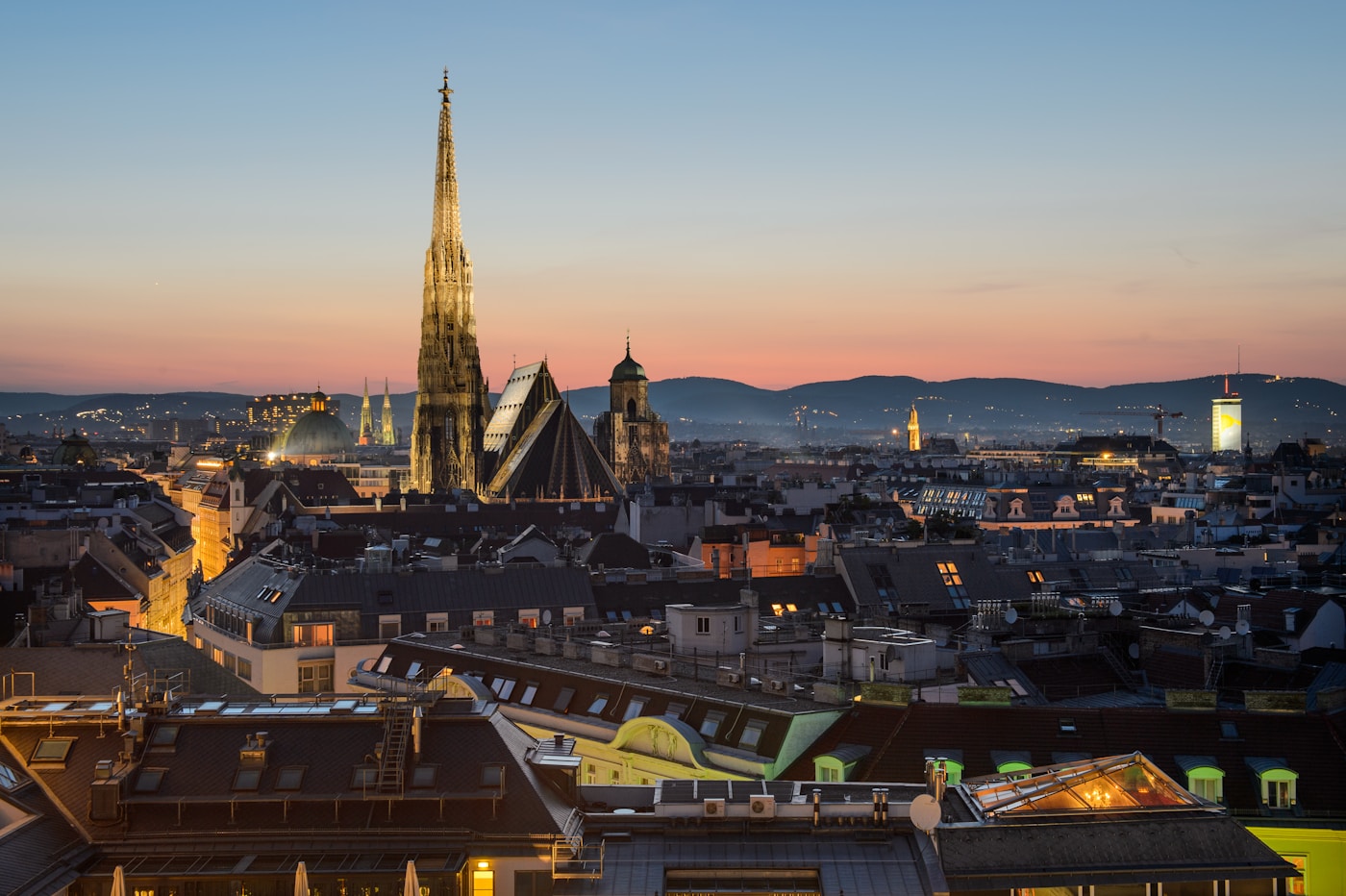
A great music city is not the one with a single famous orchestra; it is the one where the institutions run deep, the season never stops, and the music is woven into the identity of the place. The 25 cities below score highest on the everycity classical music index for May 2026, ranked on the depth of the orchestras and opera houses, the density of the season, the heritage of the composers who worked there, and how alive the music stays in the streets. Vienna leads on two centuries of the unbroken canon.
25
Cities Ranked
Vienna, AustriaThe capital of the classical canon, home of the Vienna Philharmonic and the Musikverein, the highest scoring music city on earth
№ 01 , The Top Three
The three capitals of the canon.
The top three are not the cities with a single famous orchestra; they are the cities where the institutions run deep, the season never stops, and the music is woven into the identity of the place.
Vienna is the capital of classical music, the city against which every other is measured. No other place gave the canon so many of its central figures. Mozart, Beethoven, Schubert, Brahms, Bruckner, and Mahler all worked, composed, and died here, the Strauss dynasty wrote the waltz that became the city signature, and a century later the Second Viennese School of Schoenberg, Berg, and Webern broke the tonal system open in the same streets. The Vienna Philharmonic, drawn entirely from the State Opera orchestra, is by many measures the finest in the world, and its New Year concert from the Musikverein reaches more than 50 million viewers across 90 countries.
FlagshipVienna Phil
OperaStaatsoper
EraClassical
The institutions are unmatched in density. The Musikverein and the Konzerthaus run parallel concert seasons, the Staatsoper stages near 350 performances of more than 60 operas in a single year, and the Theater an der Wien and the Volksoper fill out the calendar. A listener can hear playing of the highest order on almost any night, and the standing room tickets at the Staatsoper still sell for a few euros, the cheapest seat at the highest level anywhere on earth.
The trade is the cost and the formality. Vienna sits among the more expensive European capitals, and the scene can feel like a museum to the music of two centuries ago. But the depth is total, which is why Vienna leads on every axis the index weighs. A guided tour through GetYourGuide reaches the halls and the composer apartments, Booking.com places hotels inside the Ringstrasse, and the Vienna profile carries the cost and the practical read behind the music.
Berlin is the modern capital of classical music, the city with more on offer on a given night than any other. It carries three full opera houses, the Staatsoper Unter den Linden, the Deutsche Oper, and the Komische Oper, and at the center sits the Berliner Philharmoniker, the orchestra many rank first in the world, in the golden tented hall Hans Scharoun built for it. The city shaped the careers of Furtwangler, Karajan, Abbado, Rattle, and now Petrenko, and it absorbed the divided cold war legacy of two parallel musical establishments that reunified into the richest scene in Europe.
FlagshipBerliner Phil
OperaThree houses
EraModernist
The density is the point. On a single evening a listener can choose between the Philharmonie, the Konzerthaus on the Gendarmenmarkt, and three opera houses, and the secondary ensembles, the Deutsches Symphonie Orchester and the Konzerthausorchester, would anchor most other cities on their own. Berlin also runs the most adventurous programming of any classical capital, mixing the core repertoire with new commissions and a crossover into the club culture that no rival attempts.
The trade against Vienna is heritage rather than activity. Berlin made its name in the 20th century rather than the 18th, so the historic composer pilgrimage is thinner. But for sheer choice and ambition it is second to none. The Berlin profile carries the cost and the neighborhoods, the cheapest cities ranking tracks the value that still makes it a relative bargain among the western capitals, and Wise moves a foreign income into euros at the mid market rate.
Leipzig packs more musical history into a small city than anywhere on earth. Johann Sebastian Bach spent his last 27 years here as cantor of the Thomaskirche, where the Thomanerchor he once led still sings his motets every Friday and Saturday, an unbroken choral line that reaches back to 1212. Felix Mendelssohn founded the first German conservatory here and made the Gewandhaus Orchestra the model for the modern professional ensemble, Robert Schumann and Clara Wieck married in the city, and Richard Wagner was born in it.
FlagshipGewandhaus
Founded1212
EraBach
The Gewandhaus Orchestra is the oldest civic orchestra in the world and one of the largest, and it plays a triple role across the concert hall, the opera, and the Thomaskirche services, a continuity no other ensemble can claim. The Bach Festival each June and the Mendelssohn house, the only surviving residence of the composer, make Leipzig the essential pilgrimage for the lover of the Baroque and the early Romantic, the place where so much of the standard repertoire was first heard.
The trade is scale. Leipzig is a city of 600,000, so the sheer volume of a Vienna or a Berlin is not there. But for the concentration of history per square mile nowhere matches it, which carries it to third. A tour through GetYourGuide walks the Bach sites, the Leipzig profile carries the practical read, and the cheapest cities ranking tracks the value of a city still far below the western German average.
№ 02 , The Full Index
The full music index.
Ranked on the everycity classical music index for May 2026: the depth of the orchestras and opera houses, the density of the season, the heritage of the composers who worked there, and how alive the music stays in the city.
The index rewards depth and a living scene over a single famous hall. A city with three opera houses, two concert halls, and a season that never stops outranks one with a single great orchestra and little about it. The three columns below carry the flagship orchestra, the principal opera house, and the composer or era the city most defines. The score in the final column is the composite, with green marking a music index of 8.0 or above and amber marking 7.0 to 7.9. No city scores in the red band, because the bar for the top 25 is an index above 7.0.
Read the table by column to find the music for a given trip. The flagship column favors the orchestral capitals of Vienna, Berlin, and Amsterdam; the opera column points to Milan and Naples; and the signature column names the composer or tradition each city tells best, from Leipzig for Bach to Warsaw for Chopin. The composite balances all four axes against the integrity of the season, which is why a city with a deep heritage but a thin modern calendar ranks below a slightly less storied one that plays every night. Every city links to its full profile, where the music sits against the modern cost, safety, and climate. Read the signature column with care: it names the chapter each city tells best, but a city such as Munich or Dresden carries several traditions at once, and the single label is a door rather than the whole room.
№ 03 , The Music Geographies
Six kinds of music city.
Six distinct traditions fill this list. Knowing which one a city belongs to tells you what you are traveling to hear.
The Austro German heartland runs deepest. Vienna, Berlin, Leipzig, Dresden, Munich, and Hamburg carry the core of the canon, the cities where Bach, Mozart, Beethoven, Brahms, Wagner, and Strauss did their defining work and where the modern orchestra was invented. This is the foundational tier, the source of the symphonic and operatic repertoire that the rest of the world programs, and the institutions run unbroken for two centuries and more. A skip the queue tour through GetYourGuide reaches the famous halls without the wait.
The Italian opera capitals answer with the voice rather than the orchestra. Milan holds La Scala, the most prestigious opera house in the world, Naples the San Carlo, the oldest continuously active house in Europe, Verona the Roman arena that stages opera to 13,000 people under the open sky each summer, and Bologna a UNESCO City of Music with a season that punches far above its size. This is the home of bel canto and the grand operatic tradition, where the art form was born and still draws the great voices.
The New World orchestral capitals match the Europeans on the symphonic side. New York holds Carnegie Hall, the Metropolitan Opera, and the New York Philharmonic, Boston the Boston Symphony in the acoustically perfect Symphony Hall, and Chicago the Chicago Symphony Orchestra, long ranked among the finest brass led ensembles on earth. These cities lack the deep composer heritage of Europe but match it on the quality of the playing and the wealth of the institutions that fund it.
The concert hall cities are defined by a single great room and the orchestra that lives in it. Amsterdam holds the Concertgebouw, whose acoustic many rank first in the world, and the Royal Concertgebouw Orchestra to fill it, Paris the Philharmonie de Paris and the rebuilt opera houses, and London a remarkable five professional symphony orchestras, the Royal Opera, and the Proms, the largest classical festival on earth. London alone offers more concerts per year than any other city.
The Central European composer cities carry the national schools. Prague is the city of Dvorak and Smetana and the home of the Prague Spring festival in the Rudolfinum, Budapest the city of Liszt and Bartok with the academy Liszt founded, and Warsaw the city of Chopin and the international piano competition that bears his name every five years. These cities tell the story of the 19th century national awakening through music, and they remain far cheaper than the western capitals.
The Nordic and Alpine tier is the rising edge. Helsinki is the city of Sibelius and the gleaming Musiikkitalo, Stockholm and Copenhagen carry the royal opera houses and the legacy of Nielsen and Berwald, and Zurich pairs the Tonhalle with a leading opera house on a Swiss budget. These cities trade the deep history of the heartland for superb modern halls, strong public funding, and a quality of life that the quality of life ranking rates among the highest in the world.
Frankfurt holds the Alte Oper, the hr Sinfonieorchester, and one of the most respected opera houses in Germany. It misses the top 25 only on the depth of heritage beside its larger German rivals. See the Frankfurt profile.
Lyon pairs the Orchestre National de Lyon in its purpose built Auditorium with one of the most adventurous opera houses in France. The second city of French music, just behind Paris on depth. See the Lyon profile.
Brussels holds La Monnaie, the opera house where the 1830 Belgian revolution began, and a strong concert life surrounding the Bozar center. The scale, not the quality, keeps it outside the top tier. See the Brussels profile.
Seoul has built a serious classical scene at speed, anchored by the Seoul Arts Center and the Lotte Concert Hall, and it now exports a generation of competition winning soloists. The newest entry on the global map. See the Seoul profile.
Venice holds La Fenice, one of the most storied opera houses in Italy, and the legacy of Vivaldi, who wrote much of his work for the city orphanages. The small modern scene holds it just outside. See the Venice profile.
OperaLa Fenice
EraVivaldi
№ 04 , City Notes
The rest of the top 25.
A short read on the cities that fill out the ranking, from the Italian opera houses to the Nordic concert halls.
Milan ranks fourth on La Scala alone, the opera house that set the standard for the art form, where a premiere is still a national event and the loggionisti in the upper gallery will boo a tenor who falls short. The Milan profile carries the cost behind the glamour.
Paris takes fifth on the breadth of its scene, the Philharmonie de Paris, the Orchestre de Paris, two opera houses in the Bastille and the Garnier, and a deep early music and contemporary culture. The New York versus Paris comparison reads the two great cultural capitals against each other.
London holds sixth on sheer quantity, five professional symphony orchestras, the Royal Opera and English National Opera, the Wigmore Hall for chamber music, and the Proms, the largest classical festival in the world across eight weeks each summer. No city stages more concerts in a year.
New York ranks seventh on Carnegie Hall, the Metropolitan Opera, the largest opera house in the world by capacity, and the New York Philharmonic in the renovated David Geffen Hall. The depth of the playing is world class even where the composer heritage is young.
Amsterdam takes eighth on the Concertgebouw, whose acoustic is rated among the two or three finest concert halls ever built, and the Royal Concertgebouw Orchestra that calls it home. Few rooms anywhere reward a listener so completely.
Munich and Dresden carry the Bavarian and Saxon courts at ninth and tenth, Munich on the Bavarian State Opera and the BR Symphony, Dresden on the Semperoper and the Staatskapelle, one of the oldest orchestras in the world, with a sound built over four centuries.
Prague ranks eleventh on Dvorak and Smetana and the Prague Spring festival in the Rudolfinum, while Budapest holds twelfth on Liszt and Bartok and the academy Liszt founded. Both deliver a deep tradition at a fraction of the western European cost.
Boston takes thirteenth on the Boston Symphony in Symphony Hall, often called the most acoustically perfect room in the United States, and the Tanglewood festival that feeds it each summer. The orchestra ranks among the finest in the world.
Moscow holds fourteenth on the Bolshoi, the Tchaikovsky Conservatory, and the Moscow Philharmonic, the heart of the Russian tradition that gave the canon Tchaikovsky, Rachmaninoff, and Shostakovich, though the current isolation has thinned its international links.
Hamburg ranks fifteenth on the Elbphilharmonie, the spectacular harbor hall that opened in 2017 and reset the German concert map, and the legacy of Brahms, who was born in the city. Chicago holds sixteenth on the Chicago Symphony, long the standard for orchestral brass.
Verona takes seventeenth on the Arena, where opera plays to 13,000 people under the stars each summer, and Naples eighteenth on the San Carlo, the oldest continuously active opera house in Europe, founded in 1737, decades before La Scala.
Bologna, Helsinki, and Stockholm hold nineteenth through twenty first, Bologna a UNESCO City of Music, Helsinki the city of Sibelius and the Musiikkitalo, Stockholm the Royal Swedish Opera and a strong orchestral life. Copenhagen, Zurich, Warsaw, and Madrid close the list on the legacy of Nielsen, the Tonhalle, Chopin, and the Teatro Real, the great houses of the northern and southern edges of the European tradition.
№ 05 , Who Should Go Where
The same list, reordered by ear.
A great music city means one thing to the opera lover and another to the symphony devotee. The same list reorders depending on what you came to hear.
For the opera lover, the Italian houses and the German capitals win. Milan and Naples carry the birthplace of the art form, Vienna and Munich the deepest repertory companies, and Verona the open air spectacle of the summer arena. A ticket through GetYourGuide and a hotel near the house through Booking.com put the lover within walking distance of the curtain.
For the symphony devotee chasing the finest orchestral playing, the answer spans continents. Berlin, Vienna, and Amsterdam hold the European peak, while Boston and Chicago match them across the Atlantic. The quality of life ranking reads how these cities live beyond the concert hall.
For the early music and Baroque pilgrim, Leipzig is the destination, the city of Bach, the Thomanerchor, and the June festival, with Dresden close behind on its court Baroque and Venice on the legacy of Vivaldi. These are the cities to hear the repertoire where it was written.
For the festival pilgrim who travels for the calendar rather than the city, the summer reorders the list. Verona stages opera in the Roman arena, Prague runs the Prague Spring, and London fills eight weeks with the Proms. The best month to visit tool times the trip to the festival window.
For the student or the aspiring musician, the conservatory cities matter most. Vienna, Paris, Budapest, and Moscow hold the great teaching institutions, and a place in one shapes a career. The where should I live quiz weighs the music against the practical life of a long stay.
For the budget traveler, the Central European and eastern German cities deliver the deepest music for the least money. Leipzig, Prague, Budapest, and Warsaw pair a serious tradition with a cost far below the western capitals, which the cheapest cities ranking tracks. Wise moves a foreign income at the mid market rate to stretch the trip further.
№ 06 , Methodology
How the music index works.
The classical music index is a composite of four measured inputs, weighted to reward depth, density, and a living scene over a single famous hall.
Axis 01
The institutions
The first input is the depth of the resident institutions, the number and quality of the professional orchestras, opera houses, and concert halls. A city with three opera houses and two great orchestras, such as Berlin, scores at the top; a city with a single ensemble, however fine, scores lower. Read the full weights on the methodology page.
Axis 02
The density
We count the density of the season, the number of concerts and opera performances staged in a year, because a deep tradition is only useful to a listener if something plays tonight. London and Vienna lead this axis on sheer volume; a city with a short season scores lower regardless of its heritage.
Axis 03
The heritage
We weight the historical depth, the composers who lived and worked in the city and the premieres it hosted, because the music carries more meaning where it was written. Leipzig and Vienna score highest here; the New World cities, younger in this respect, lean on the institutions axis instead.
Axis 04
The living scene
We score how alive and accessible the music stays, the festivals, the conservatories, and the price of a ticket. Vienna, where a standing room seat at the opera costs a few euros, leads this axis; a city where the music is excellent but priced out of reach scores lower.
The index refreshes quarterly. The institutions and density axes draw on the published seasons of the orchestras and opera houses and the annual Bachtrack concert statistics, the heritage axis on the historical and musicological record, and the living scene on festival calendars, conservatory rankings, and our editors assessment of ticket access against a fixed rubric. Where a city claims a great tradition with a thin current season, we score the living calendar rather than the legend.
If a city you expected is missing, it most likely fell on density or the living scene: a deep heritage that no longer fills a season, or a single great hall with little about it, cannot reach the top tier on this methodology. For the music folded into the wider quality of a trip, see the history and foodies rankings, and the remote work ranking for the cities that pair the music with a place worth a long stay. The relocation score tool and the cost of living calculator cover the practical side of a move built on the music.
One reading note on what the index cannot capture. The feeling of a particular hall on a particular night, the sound of the Musikverein at full tilt or the Concertgebouw in a quiet Mahler adagio, resists a number, and two cities with the same score can deliver entirely different evenings. We hold the four measured axes as the comparable spine and leave the atmosphere to the city profiles, where the street level detail lives. The honorable mentions above, and the dozens of serious music cities that fell just outside the top 25, are a reminder that the line between rank 20 and rank 35 is thin, and that the best music city for a given listener depends on what pulls hardest, the voice, the orchestra, or the history.
№ Subscribe
The Monthly Mover.
One letter a month: the cities that rose, the cost shifts that matter, and the cultural rankings worth a trip. No tourism boards, no sponsored placement, just the numbers.
Sources, May 2026. Bachtrack annual classical concert and opera statistics 2025 · the orchestras, opera houses, and festivals named · UNESCO Creative Cities of Music · Numbeo Cost of Living May 2026 · everycity classical music index methodology. First published May 25, 2026. Last updated May 25, 2026. everycity.guide is independent and takes no tourism board funding.